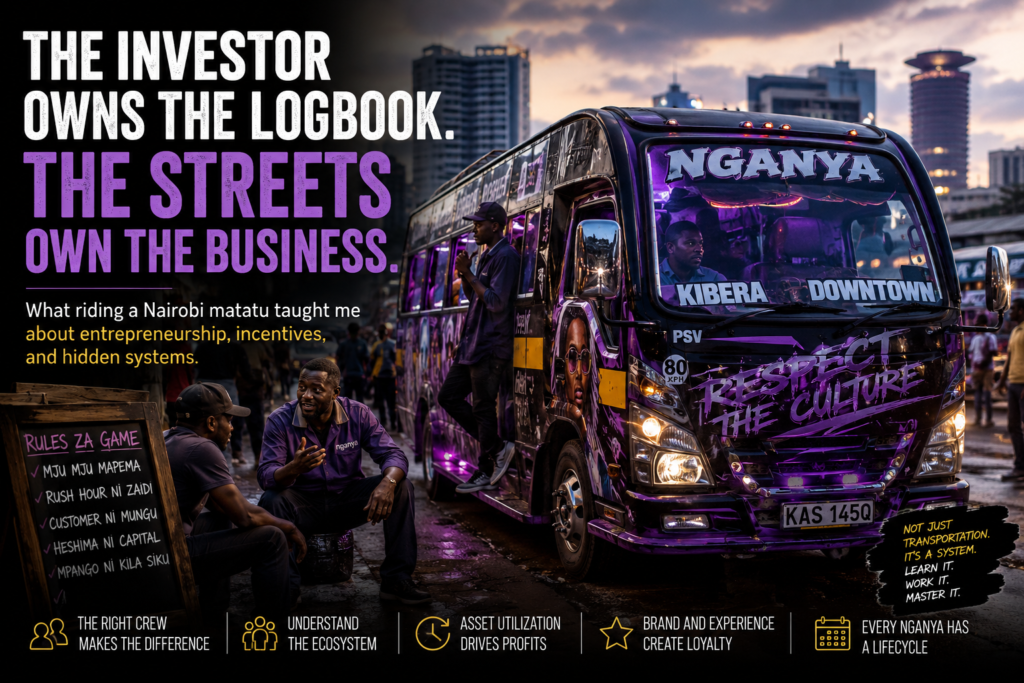
A few days ago, I read the story of a former matatu owner from Nairobi who described how buying a 14-seater matatu nearly ruined his life. His story was familiar. Corrupt police officers, aggressive stage cartels, dishonest crews, endless repairs, Sacco fees, and sleepless nights. His conclusion was simple: the owner only owns the logbook, while everyone else owns the vehicle.
I understood exactly what he was talking about.
But my experience taught me a slightly different lesson.
The streets own the business only if you never take the time to understand the streets.
My Mother’s Matatu
In the early 2000s, my mother purchased a matatu operating between Kibera and downtown Nairobi.
Like many first-time investors, she believed the business was straightforward.
Buy a vehicle.
Hire a driver and conductor.
Collect fares.
Earn profits.
The returns were disappointing.
Every evening we received roughly KSh 1,500 to KSh 2,000. The vehicle seemed busy enough during the day, yet somehow very little money reached the owner.
My mother trusted the driver because she had been told he was a good Luo man from Kibera. That seemed like a reasonable qualification.
What we did not realize was that we owned a vehicle but knew almost nothing about the ecosystem surrounding it.
So I did something unusual.
I started riding the matatu.
Not once.
Not twice.
Regularly.
I sat with the driver.
I spent time with the conductors, or “makanga.”
I learned their slang.
I ate where they ate.
I listened more than I spoke.
And slowly, the business began revealing itself.
The University of the Streets
Business schools teach finance.
The streets teach incentives.
The first thing I discovered was that the people closest to the business often understood it better than the investors.
The conductors already knew things the owners did not.
For example, they knew that a successful nganya—the heavily customized, music-filled matatu that passengers loved—had a lifespan of roughly six to eight months.
Not years.
Months.
Owners often believed they were buying a long-term asset.
The crews knew they were managing a fashion product.
A nganya was not transportation.
A nganya was culture.
It was music.
It was identity.
It was status.
Like fashion, trends faded.
A new design would appear.
A new sound system would arrive.
A new vehicle would become popular.
The smartest operators prepared to sell while demand remained high and use the proceeds to upgrade into the next trend.
The crews knew this.
Many owners did not.
The Driver Matters More Than The Vehicle
My second lesson was even more important.
Not all drivers were equal.
The driver my mother hired had one qualification:
He was recommended as a trustworthy man.
The streets had a different qualification.
They spoke about “driver mjanja.”
The clever driver.
The versatile driver.
The respected driver.
The driver who understood people.
The driver who knew how to navigate the system.
The driver who knew every stage, every shortcut, every traffic pattern, and every unwritten rule.
The conductors also had another phrase: “driver wa rangi.”
Literally, a stylish or attractive driver.
At first this sounded funny.
Then I understood.
Passengers are human beings.
People naturally gravitate toward confidence, professionalism, charisma, and presentation.
Even transportation contains elements of marketing.
Eventually, I convinced my mother to replace the original driver with a well-known driver recommended by the route itself.
That decision changed everything.
The Transformation
We decided to transform the vehicle.
The original seats were removed.
Custom upholstered seats were installed.
The interior received a blue-purple theme.
Purple tube lighting was added.
A proper sound system was installed with separate amplifiers for bass and mid-range frequencies.
A crossover smoothed the sound.
A Sony Xplod system became the heart of the entertainment setup.
The radio face could be removed instantly, stopping the music whenever necessary—an amusing but practical feature during encounters with law enforcement.
Then came the branding.
The vehicle no longer looked like transportation.
It looked like an experience.
On the first night of operation, the matatu returned home with roughly KSh 6,000 in profit.
Fuel paid.
Driver paid.
Conductor paid.
Vehicle washed.
Ready for the next day.
That was the moment I realized we had misunderstood the business.
Passengers were not buying transportation.
They were buying an experience.
Repeat Customers
Another surprise awaited me.
My mother assumed passengers simply boarded whichever vehicle arrived first.
That was not true.
Some passengers intentionally waited for specific matatus.
They knew the vehicles.
They knew the crews.
They preferred the atmosphere.
They preferred the music.
They preferred the ride.
In modern business language, these were loyal customers.
The vehicle itself was not our greatest asset.
The customer loyalty was.
Rush Hour Economics
Perhaps the most fascinating lesson involved rush hour.
Most outsiders calculate matatu revenue incorrectly.
They assume:
Passengers × Fare = Revenue.
The streets taught me something different.
During rush hour, fares often doubled.
Sometimes more.
Meanwhile, popular nganyas filled before reaching downtown.
Instead of spending time waiting at the final stage, they could immediately turn around and begin another trip.
This created a powerful multiplication effect.
Higher fares.
More passengers.
More trips.
The difference between an average matatu and a successful nganya was not merely the vehicle.
It was asset utilization.
The best crews understood how to keep the vehicle moving.
The owner saw a bus.
The crews saw a revenue-generating machine whose profitability depended on minutes, not hours.
Lunch Was Not Lunch
Another lesson emerged from simply spending time with the crews.
Many managers view lunch breaks as unproductive time.
The drivers and conductors understood something different.
Lunch was where information flowed.
At these gathering spots they exchanged knowledge.
Traffic conditions.
Police activity.
Passenger demand.
Stage politics.
Vehicle performance.
Emerging trends.
Competitors.
What looked like idleness was actually intelligence gathering.
The street version of a corporate board meeting was often a shared meal and a conversation.
The Mistake Many Investors Make
Years later I realized this lesson extends far beyond transportation.
Many investors purchase assets before understanding ecosystems.
A farmer buys land before understanding markets.
A landlord buys property before understanding tenants.
A developer builds software before understanding users.
A construction investor funds a project before understanding contractors.
A matatu owner buys a vehicle before understanding drivers.
The pattern is always the same.
People fall in love with the visible asset while ignoring the invisible network surrounding it.
Yet the invisible network is often where value is created or destroyed.
What Toyota, Anthropologists, and Matatu Crews Have in Common
One of the most respected management concepts in the world comes from Japan.
Toyota developed a principle called “Go to the Gemba.”
It means:
Go where the work actually happens.
Do not manage from reports.
Do not manage from assumptions.
Go and observe.
Interestingly, anthropologists use a remarkably similar method.
Instead of interviewing people from a distance, they immerse themselves in the culture.
They participate.
They observe.
They learn the language.
They become part of the environment.
Without realizing it, that is exactly what I did.
I did not improve the business by reading accounting books.
I improved it by becoming a temporary member of the ecosystem.
The conductors became my teachers.
The drivers became my teachers.
The streets became my classroom.
The Real Lesson
People often ask whether the matatu business is profitable.
I believe that is the wrong question.
The better question is:
Do you understand the ecosystem?
The investor owns the logbook.
The streets own the business.
But that ownership is not permanent.
The moment you understand the culture, incentives, workflows, relationships, customers, and information flows, you begin reclaiming ownership of the business itself.
My mother thought she owned a matatu.
The driver thought he drove a route.
The conductor thought he collected fares.
What I eventually discovered was something much larger.
We were all participating in a living ecosystem governed by reputation, culture, incentives, relationships, timing, and information.
The vehicle was merely the shell.
The business lived in the streets.